Physical Address
304 North Cardinal St.
Dorchester Center, MA 02124
Physical Address
304 North Cardinal St.
Dorchester Center, MA 02124
Global Korea Scholarship 2027 (GKS-U) is fully funded: tuition, monthly stipend, a Korean language year and round-trip airfare. Embassy track closes end of September 2026.
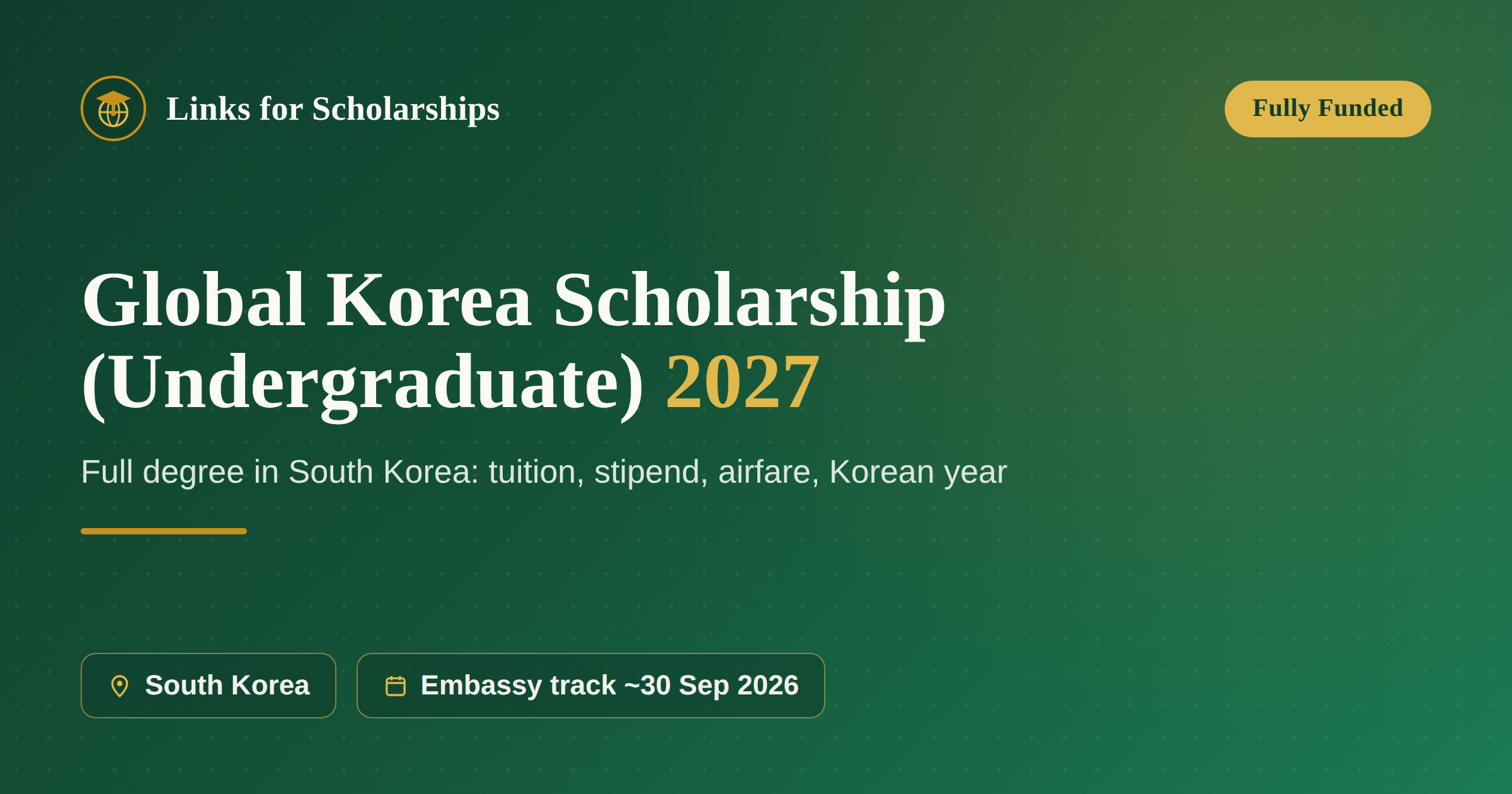
The Global Korea Scholarship 2027 for undergraduate students, GKS-U, is fully funded. It covers your full tuition, a monthly living stipend, one year of Korean language training, and round-trip airfare to and from Korea, for a full bachelor’s or associate degree in South Korea.
It is run by the Korean government through NIIED, and this cycle offers 286 scholarships to students from around the world. It is for students who have finished high school or will finish soon, and you apply either through the Korean embassy in your country or directly through a Korean university.
| Detail | Information |
|---|---|
| Host country | South Korea |
| Provider | Korean government (NIIED, Global Korea Scholarship) |
| Study level | Undergraduate (bachelor’s and associate degree) |
| Funding | Fully funded: tuition, monthly stipend, one year of Korean language study, round-trip airfare |
| Who can apply | High school graduates (or soon to graduate) under 25, from an eligible country |
| Number of awards | 286 scholars (156 embassy track, 130 university track) |
| Application fee | None for the scholarship |
| Deadline | Embassy track: end of September 2026 (check your Korean embassy). University track: September–November 2026. See the Deadline section. |
The Global Korea Scholarship, GKS, is South Korea’s flagship government scholarship for international students. The undergraduate version, GKS-U, pays for a full degree at a Korean university, from your first year to graduation.
You get one year of Korean language training first, then your degree. For a bachelor’s that means one year of Korean plus four to six years of study. For an associate degree it means one year of Korean plus two to three years of study. By the time you graduate you have a Korean degree and you speak the language.
GKS also adds the usual government-scholarship support around these, such as a settlement allowance when you arrive and medical insurance. Confirm the full current benefit list in the official 2027 guidelines when you apply, because NIIED sets the exact figures each year.
There are two ways in, and you choose one.
The embassy track means you apply through the Korean embassy in your own country. You can name up to three universities. The competition is with other students from your country.
The university track means you apply straight to one Korean university that takes GKS-U students. The competition is with students from everywhere applying to that same school.
You cannot use both tracks in the same year, so pick the one that fits you and put your full effort there.
Yes. You must be under 25 on the program start date, which means born on or after 1 March 2002 for this cycle. If you finished secondary school recently and have not started a degree yet, you likely still qualify. Check the exact date rule in the official guidelines for your track.
You do not need to speak Korean to apply, because the scholarship gives you a full year of Korean training first. An English test like TOEFL or IELTS, or a Korean test like TOPIK, can strengthen your application and is required by some universities, so a score helps. If you do not have one yet, you can still apply, and you can start preparing now.
GKS is competitive and grades matter. The program usually asks for a grade average in the top 20 percent of your class, or the equivalent on a GPA scale. If your grades sit below that, check the exact cut-off for your track, and remember your essays, your plan of study, and your recommendation letters are read too. A strong overall application still counts.
Always build your final list from the official 2027 guidelines for your track, because embassy and university requirements differ.
These two essays carry a lot of weight. The self-introduction is your story: where you come from, what shaped you, why Korea. The study plan is your future: what you want to study, why that field, and what you will do with the degree. Write in your own plain voice, use real detail from your life, and keep to the length they ask for. Read both aloud before you submit, and have one person you trust check them.
Applications are screened first for eligibility and documents, then reviewed on grades, essays, and references. Embassy track applicants are shortlisted by the embassy, then sent to NIIED and the universities. University track applicants are reviewed by the university, then confirmed by NIIED. Final results for this cycle are announced on 7 January 2027.
Embassy track: closes at the end of September 2026. University track: September to November 2026.
The embassy track is the tight one. NIIED’s overall date is 30 September 2026, but each Korean embassy sets its own earlier internal deadline, so check the embassy in your country today and work to their date, not the general one. University track deadlines vary by school across September to November. Confirm the exact date and time for your route on the official source before you submit.
Drop your question in the comments and we will help. If you are choosing between the embassy and university tracks, tell us your country and we will point you the right way.
We post fully funded scholarships like this one every week.

Always confirm requirements and deadlines on the official application page. Do not share documents or sensitive personal information.




[…] Global Korea Scholarship 2027 (GKS-U) […]
[…] Global Korea Scholarship 2027 (GKS-U) […]