Physical Address
304 North Cardinal St.
Dorchester Center, MA 02124
Physical Address
304 North Cardinal St.
Dorchester Center, MA 02124
The Erasmus Mundus PlantHealth Scholarship 2027-2029 pays full tuition, insurance and €1,400 a month for a master’s in Spain, Italy, Germany or France.
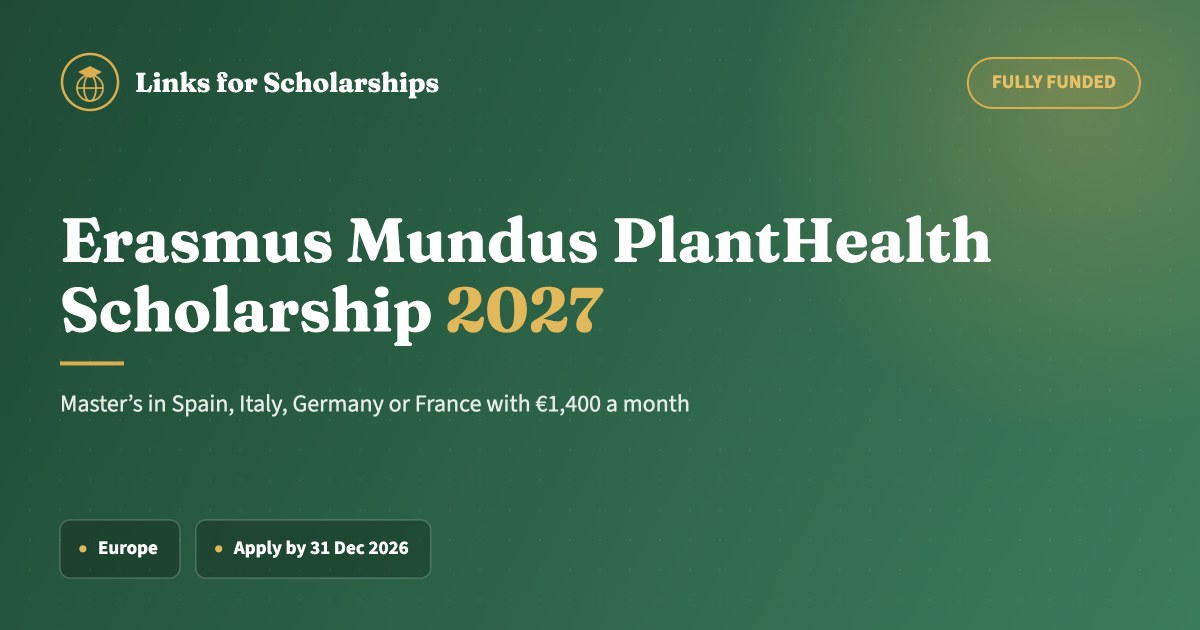
The Erasmus Mundus PlantHealth Scholarship 2027-2029 is fully funded by the European Union. It pays 100% of your tuition fees, full insurance and mandatory academic costs, plus a stipend of €1,400 a month for up to 24 months to cover travel, visa, installation and living costs, for a two-year joint master’s in plant health and sustainable cropping systems in Europe.
You study the first year in Spain or Italy and the second year in a different country: Spain, Italy, Germany or France. The programme takes up to 30 students from all over the world, and it is open to EU and non-EU applicants with a bachelor’s degree in agronomy, agricultural sciences or a related field.
| Detail | Information |
|---|---|
| Host countries | Spain, Italy, Germany, France |
| Provider | European Union (Erasmus Mundus), PlantHealth consortium led by Universitat Politècnica de València |
| Study level | Master’s (2 years, 120 ECTS) |
| Funding | Fully funded: 100% tuition, insurance, €1,400 a month for up to 24 months |
| Who can apply | Any nationality, bachelor’s in agronomy or agricultural sciences, English B2 |
| Places | Up to 30 students |
| Application fee | None mentioned |
| Deadline | 31 December 2026 (before 1 Jan 2027, 00:00 CET) |
PlantHealth is an Erasmus Mundus Joint Master’s Degree in Sustainable Cropping Systems, coordinated by the Universitat Politècnica de València in Spain. It trains specialists in integrated pest management and crop protection across different climates and farming systems.
In the first year (M1), all students take common courses in crop science, crop protection, population biology, molecular biology and statistics, at either the Universitat Politècnica de València (Spain) or the Università di Padova (Italy). All M1 courses are in English.
In the second year (M2), you specialise at a partner university in a different country and write your master’s thesis:
For context, the participation fee for non-EU students without a scholarship is €5,500 a year. The scholarship pays it in full.
Yes. If you will graduate before the end of August 2027, you can apply with a certificate from your university saying you are in your final year, plus your latest transcript.
You need proof of English at B2 level from an internationally recognised test. Duolingo, TOEIC and certificates from online courses or language schools are not accepted. A letter from your university confirming your degree was taught in English is accepted, but an official test certificate is preferred.
Only for the French second-year track. The programme gives French classes in year one and a free two-month intensive summer course before year two in France.
No application fee is mentioned.
Legalised or apostilled documents are not needed at the application stage.
You only have 1,000 characters, about 150 words. Every line counts.
See our full guide on how to write a motivation letter for a scholarship.
Candidates are scored on academic record and merits (60%), reference letters (20%) and personal motivation (20%). 80% of scholarships go to the best-scored candidates, spread across regions. The remaining 20% go to high-scoring applicants facing greater vulnerability, such as refugees, low-income students or students with special needs. Results are published at the end of February 2027.
Deadline: 31 December 2026 (applications must be in before 1 January 2027, 00:00 CET)
Only this first call offers Erasmus Mundus scholarships. A second round from 20 May to 15 June 2027 is for self-funded students only.
Ask in the comments and we’ll help where we can.
We post new fully funded scholarships, fellowships and exchanges every day. Join our WhatsApp channel or follow us on TikTok so the next one reaches you first.

Always confirm requirements and deadlines on the official application page. Do not share documents or sensitive personal information.